
Krafton Uses Video Game Character Development to Build Physical Robots with Embodied AI
The global gaming company behind PUBG: Battlegrounds is applying lessons from AI game character design to create socially intelligent physical robots through its subsidiary, Ludo Robotics.
For decades, the line between a video game character and a thinking machine seemed fixed — one was code following a script, the other a distant ambition. Krafton, the global gaming company behind PUBG: Battlegrounds, has been working to dissolve that line. By studying what happens when embodied AI must interpret, respond to, and adapt around a real person inside a live, chaotic game environment, the company is generating insights that now inform the development of physical robots designed to function in the unpredictable settings of everyday human life.
Why Scripted Game Characters Fall Short in a Dynamic World
The classic non-player character, or NPC, has long defined how artificial intelligence appears in games. Ask it a question and it delivers a preset answer, standing motionless regardless of what happens next. It does not notice when the player has already moved on, it does not adjust when the battlefield shifts, and it offers no response to context it was not specifically programmed to recognize. For years, that level of interactivity was acceptable. As player expectations and AI capabilities grew, however, the gap between what a game character could do and what felt genuinely immersive became harder to ignore.
Krafton approached this challenge not as a purely technical exercise but as a design question with real behavioral stakes. The company began exploring whether an AI character could maintain meaningful, continuous interaction with a player across a full match — not just answering isolated queries, but tracking evolving circumstances and making decisions accordingly. That question led directly to what the company describes as embodied AI: an AI system that exists within an environment, perceives it, communicates within it, and changes its behavior as conditions change around it.
Embodied AI refers to artificial intelligence that operates within and interacts with a physical or simulated environment rather than simply processing inputs and generating text outputs. Unlike a standard language model, an embodied AI system must integrate perception, reasoning, communication, and action simultaneously — and revise its behavior mid-task when circumstances shift. Video games, with their real-time, dynamic environments, offer a natural testing ground for developing these capabilities.
Inside the PUBG Ally Beta: Testing AI Companionship in Live Combat
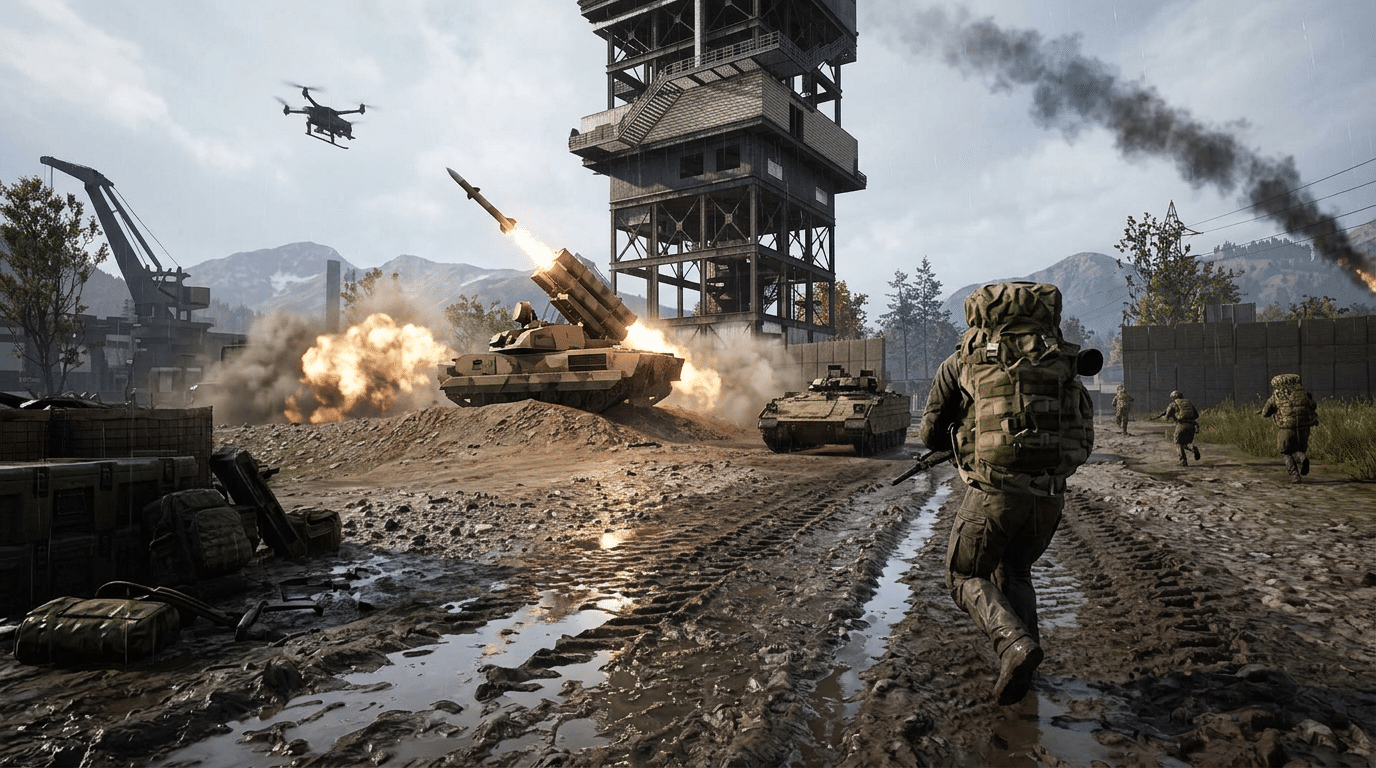
To put the concept into practice, Krafton developed PUBG Ally — a Co-Playable Character (CPC) built to fight alongside human players rather than against them. The system was tested in a limited beta through the Ally Duo mode within PUBG: Battlegrounds Arcade, which ran for players globally from June 17 to July 1, 2026. In this mode, a solo player teams up with an AI companion named Ella on the Sanhok map, communicating through voice while making real-time decisions around movement, item collection, and strategy.
Ella was not designed around a fixed decision tree. She was built to read the situation and choose an appropriate response in the moment. Built on an on-device Small Language Model (SLM) powered by NVIDIA ACE and trained on PUBG-specific knowledge — including map landmarks, items, and in-game terminology — the system supports voice communication in English, Korean, and Chinese. Because it runs on the player’s own device, it avoids network delays: according to Krafton, multi-step reasoning completes in under five seconds on-device, compared to more than ten seconds when routed through the cloud.
What Players Actually Did When AI Became a Teammate
Putting Ella into players’ hands produced results the team had not fully anticipated. The goal was never simply to build the most technically sophisticated bot possible. The more fundamental question was what happens when an AI must sustain an ongoing interaction with the same person across an entire match that keeps changing around them both. Many players talked to Ella well beyond giving tactical commands — chatting with her and testing how she would react — so much so that coverage of Krafton’s findings summed it up as “built a teammate, got a chat partner.”
Krafton’s own scorecard was candid about the gap between goal and outcome. About half of surveyed players saw Ella mainly as a tool, roughly a third as a companion, and only 18.5% as the true teammate the company intended. Players rated her combat skill lowest of all categories, while information and tactics were the most-cited strengths. Those results clarified something important: the standards people apply to a companion differ from those they apply to a tool. Whether an AI appears to be paying attention, grasps what a player intends rather than just what they said, and adjusts when plans change mid-match matters as much as raw accuracy — and that is the bar Krafton is now working toward.
“Ally Duo is an early step toward exploring how AI companions can create new ways to play.”
— Kangwook Lee, Chief AI Officer, KraftonHow Game AI Principles Are Crossing Over into Physical Robot Intelligence
The architecture underlying PUBG Ally separates a slower, deliberative language model layer from a faster, reactive action control layer that handles movement and combat in step with the game — allowing both to run at the same time. That dual-layer design carried over into the challenges of physical robotics. The robot agent Ludi 0.1, developed by Krafton’s robotics subsidiary Ludo Robotics, inherited the core design principles established through PUBG Ally and applied them to real-world conversation, memory, navigation, and object manipulation.
Ludo Robotics operates out of Palo Alto, California, with an additional office in Seoul, South Korea. The subsidiary was established by Krafton to pursue physical AI and robotics research, with Krafton’s Chief AI Officer Kangwook Lee serving as CTO of Ludo Robotics and head of its Korean branch. The research team behind Ludi 0.1 includes University of Wisconsin–Madison professor Robert Nowak and Yea-Seul Kim. Published on August 19, 2026, Ludi 0.1 uses an agentic architecture — a fine-tuned vision-language model paired with a control harness that manages the interaction loop — rather than relying on a single end-to-end model.
Perception
The system reads its surrounding environment through a vision-language model, interpreting what is happening around it in real time.
Social Reasoning
Rather than reacting only to explicit commands, Ludi 0.1 is designed to infer human intent and track the state of an interaction across multiple exchanges.
Dialogue & Memory
The system manages conversation, memory, and context so that responses reflect what has already occurred during an interaction — not just the most recent input.
Physical Action
Ludi 0.1 combines reasoning with manipulation and navigation, allowing the robot to carry out tasks in real environments and adapt if plans change.
The Open Problem: Robots That Behave Naturally Around Real People
What Ludo Robotics is working toward remains one of the most difficult unsolved problems in the field. Many robotic systems are built around a narrow capability — perceiving a defined set of inputs, carrying out a set of physical motions, or holding a conversation — but rarely all of these at once, in real time, in the unstructured environments people actually live in. The gap between a robot that performs a task in a controlled lab and one that can operate naturally alongside a person in a home, office, or public space is significant.
Krafton has said it intends to draw on technology and interaction data from its games — including PUBG: Battlegrounds and inZOI — as a resource for physical AI research, with simulation and game expertise feeding into robotics experiments. The environments are not equivalent — a robot that misjudges a situation can knock over furniture or bump into a person in ways a game character never could — but the underlying challenge is the same. Intelligence is only genuinely useful when it can do more than answer. It must understand what was meant, adapt to what changes, and act in a way that the person beside it can follow and trust.
Krafton is applying the design principles developed for PUBG Ally — an AI teammate that perceives, adapts, and communicates during live gameplay — to Ludi 0.1, a socially intelligent robot agent built by its Palo Alto-based subsidiary Ludo Robotics.
From Battle Royale Matches to Real-World Robot Intelligence
What began as an experiment in whether a game AI could keep pace with a human player across a changing match has grown into an effort to carry those lessons into machines that share physical space with people. Krafton’s trajectory — from scripted NPCs to a voice-responsive AI squadmate to a robot agent built for social reasoning — suggests that the gaming industry’s long experience designing interactive, adaptive, character-based AI may hold practical lessons for robotics. As AI moves from generating virtual responses to taking action in the real world, the training ground of play may prove to be one of its most useful environments.