

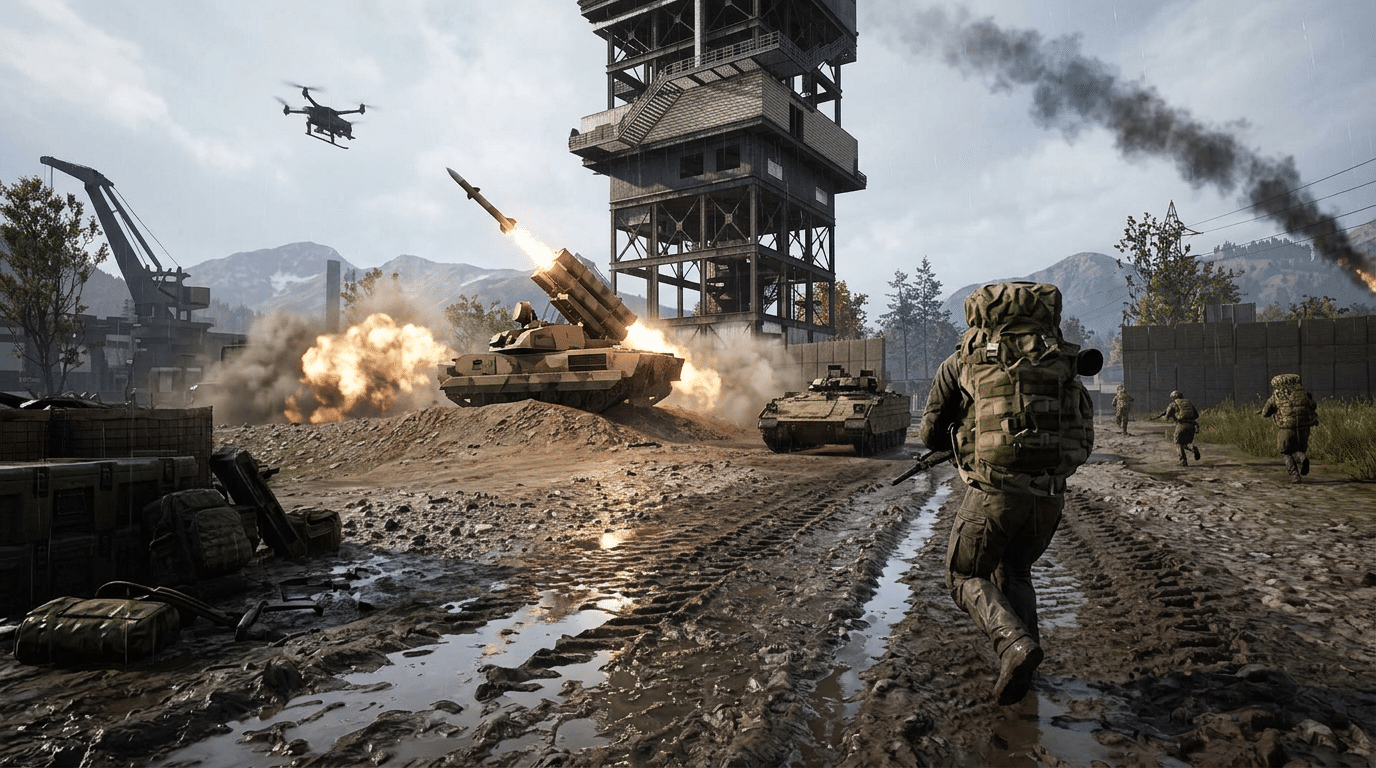
Wardogs, the 100-player tactical military shooter developed by Bulkhead and published by Team17, has delivered one of the most striking launch-day sales performances of 2026, moving 1.25 million copies within the first 24 hours of its Steam Early Access debut on September 10. The achievement arrived alongside significant growing pains — overwhelmed servers, queues stretching past 300,000 players, and a wave of negative Steam reviews that briefly pulled the game’s rating into “Mixed” territory — yet none of it was sufficient to slow the momentum that Bulkhead had been quietly building for months. The numbers speak plainly: in a year that has seen multiple high-profile multiplayer shooters stumble badly, an independent British studio just posted one of the biggest opening days the FPS genre has seen in recent memory.
How Wardogs Built Its Massive Steam Wishlist Before the Early Access Launch
The groundwork for Wardogs’ explosive debut was laid long before the game went live. Interest in the project snowballed rapidly after its announcement: the game crossed 100,000 Steam wishlists within three days of being revealed, surpassed 500,000 by May, and then cleared the one-million mark in August — a figure more commonly associated with major AAA releases rather than a UK independent studio best known for The Turing Test and Battalion 1944.
The closed beta, which ran from August 21 to 23 and was restricted to players who had pre-ordered the game, attracted nearly 500,000 unique participants over three days. Concurrent players on the beta’s dedicated Steam Playtest listing peaked at 105,774 on the final day of testing, a figure that surpassed the all-time concurrent player records of established mil-sim titles Squad and Arma on Steam. That level of pre-launch enthusiasm made clear that demand for Early Access would be substantial — though the scale of it would still catch the infrastructure off guard.
Bulkhead CEO Joe Brammer took a deliberately transparent approach to marketing rather than relying on industry hype cycles. The studio spent months laying out in concrete terms exactly what Wardogs is — and, crucially, what it is not. At one point, Bulkhead even published a public list of ten reasons not to purchase the game at launch, explicitly discouraging players who might buy on impulse and feel disappointed. That honesty appeared to generate the kind of pre-launch goodwill that money typically cannot buy.
Server Queues and Review Bombing Cloud an Otherwise Historic Multiplayer FPS Debut
When Wardogs officially unlocked on Steam at 16:00 UTC on September 10, the volume of players attempting to connect simultaneously overwhelmed the game’s server infrastructure almost immediately. Queue positions climbed past 300,000 for many players, meaning some faced waits measured in hours rather than minutes. The situation was compounded by a last-minute change to the anti-cheat system, which meant the game no longer ran via Proton — locking out a portion of Linux users — and by crashes that sent players who had endured lengthy queues back to square one.
Bulkhead issued a hotfix shortly after launch, pushing players into servers in controlled batches and working directly with Valve to resolve a rate-limiting problem on Steam’s backend. By midnight UTC on September 11 — the morning after launch — the studio confirmed that queue issues had been resolved. The development team’s official messaging throughout the chaos was measured: they thanked players for their patience, apologized for the disruption, and noted publicly that they were watching server data and monitoring gameplay conditions in real time.
The core issue was capacity, not a server crash. Bulkhead implemented a login queue to protect server stability rather than turning players away outright. With peak concurrent players hitting above 300,000, queue positions climbed to extraordinary lengths. Bulkhead confirmed that part of the slowdown stemmed from Valve rate-limiting the game on Steam’s side — a problem the studio resolved by working directly with Valve engineers. The servers themselves were operational throughout; the bottleneck was at the login layer.
The server struggles triggered a wave of negative Steam reviews that temporarily pushed the game’s rating into “Mixed” territory. Some players raised concerns that streaming personalities and content creators had been given priority server access over paying customers — an allegation that Bulkhead neither confirmed nor denied publicly. Despite the rocky start, the game rebounded to a “Mostly Positive” rating of 78 percent in the days following launch, as players who successfully entered the game reported a positive gameplay experience.
The Cash-Driven Gameplay Loop That Is Winning Over the Tactical FPS Community
At its core, Wardogs pits 100 players across three competing factions — Valkyra, Lonestar, and Manticore — in large-scale battles for randomized 2×2 kilometer Control Zones within much larger maps. The team that accumulates the most players inside a zone earns points on a rolling timer, with the first faction to reach 100 points claiming victory. What separates Wardogs from similar games in the tactical FPS space, however, is its persistent in-game economy. Players begin each session with a cash balance and spend it to purchase loadouts, vehicles, and equipment before each life. Dying means losing whatever was equipped — creating a genuine risk-reward tension absent from many contemporaries.
Bulkhead has deliberately positioned Wardogs in the space between Battlefield’s mainstream accessibility and the demanding mil-sim approach of titles like Arma or Squad. The game launched into Early Access with 37 weapons, 21 vehicles, and three maps, each featuring multiple variations. Features such as destructible structures, base building, and proximity voice chat layer additional depth onto the combat, while flyable helicopters — which players can use to ferry troops and supplies — give pilots a distinct and commercially viable role on the battlefield.
The cash system functions as the game’s deepest mechanism for encouraging cooperative play without mandating it. A medic who revives downed teammates earns money for the service. A pilot who successfully delivers troops earns a tip if passengers choose to reward the journey. A builder who fortifies a forward operating base earns income through the value generated. The result, as players and critics have observed since beta, is that virtually every role on the battlefield has an economic incentive built into it — a design choice that makes teamwork feel financially rational rather than simply morally desirable.
A Difficult Year for Competitive Shooters Makes Wardogs’ Sales Numbers Stand Out
The significance of Wardogs’ debut cannot be fully understood without considering the broader landscape of competitive multiplayer games in 2026, which has been marked by a string of high-profile failures. Highguard, developed by Wildlight Entertainment — a studio composed largely of former Respawn Entertainment veterans — launched on January 26 to initial interest but saw its player base collapse with remarkable speed. The free-to-play hero shooter shut down just 45 days after release, with a former developer later attributing part of its failure to gameplay that was considered too mechanically demanding for casual players to persist with.
Bungie’s Marathon, released in March 2026 as a PvP extraction shooter, encountered its own turbulent journey. Despite receiving generally positive critical notices, Marathon failed to meet the commercial expectations of either Bungie or its distributor Sony Interactive Entertainment. The game’s struggles — arriving shortly after Highguard’s shutdown — contributed to layoffs at Bungie, with Sony redirecting studio focus away from Destiny 2 and toward keeping Marathon operational. The situation illustrated the precarious position even established studios can find themselves in within the live-service market.
Empulse, developed by 1047 Games as a movement-focused spiritual successor to Titanfall, launched into Steam Early Access in June 2026 to mixed reception. By August 26, 1047 announced it was ending active development on both Empulse and its predecessor Splitgate: Arena Reloaded, with the studio citing an inability to generate sufficient revenue to maintain dedicated server costs. Both games transitioned to peer-to-peer networking on September 3. 1047 indicated it would be shifting focus away from live-service shooters entirely after a decade in the genre.
Against that backdrop, Wardogs’ opening numbers are striking. The game not only moved 1.25 million copies in under 24 hours but also briefly climbed to become one of the top three most-played titles on Steam, trailing only Counter-Strike 2 and Dota 2 in peak concurrent users. It reached the number-one position on Steam’s global best-seller chart on launch day — doing so while competing directly with the early access beta period of Call of Duty: Modern Warfare 4, which entered testing on the same date. That Wardogs, a $39.99 title from an independent studio, could occupy the same competitive conversation as one of gaming’s most commercially dominant franchises is itself a measure of how far the game has traveled in a short time.
Roadmap, Console Plans, and the Long-Term Outlook for Wardogs’ Early Access Run
Bulkhead has been candid about the expectations players should hold during the Early Access period. The studio has stated openly that players should not anticipate regular scheduled content drops, with development focus in the near term directed toward bug fixes, server stability, balance tuning, and building out the game’s metagame systems. One additional map is confirmed for the Early Access window, with further weapons, vehicle categories including fighter jets, new objective types, and deeper progression features planned for the period before a full 1.0 release — which Bulkhead is targeting roughly 24 months after the September 2026 launch, pointing to approximately September 2028.
That 2028 window also aligns with Bulkhead’s confirmed timeline for console versions of Wardogs. At launch, the studio announced that PlayStation 5 and Xbox Series X and Series S editions are planned for 2028, with the game currently exclusive to PC via Steam. The Early Access price of $39.99 is expected to rise incrementally as content is added, eventually reaching $59.99 at the full 1.0 release — an intentional inversion of the typical discount model that rewards players who buy in earlier rather than waiting.
Related Posts

Krafton Uses Video Game Character Development to Build Physical Robots with Embodied AI
GAME AI PHYSICAL AI EMBODIED AI Technology & AI Krafton Uses Video Game Character Development to Build Physical Robots with Embodied AI The global gaming…
WARDOGS Season 2 Release Date Confirmed: October 15 Wipe, New Rain Weather, Anti-Aircraft Vehicles and Infantry Mode Coming
SEASON 2 — OCTOBER 15, 2026 Game Update WARDOGS Season 2 Release Date Confirmed: October 15 Wipe, New Rain Weather, Anti-Aircraft Vehicles and Infantry Mode…

Microsoft Announces Major Xbox Restructuring With 268 Layoffs, Halo Moves to Activision, and Studio Closures
Gaming Industry News Microsoft Announces Major Xbox Restructuring With 268 Layoffs, Halo Moves to Activision, and Studio Closures A sweeping new phase of Microsoft’s Xbox…